

 Send Email
 whatsapp


Microfilament vs Traditional Nonwoven: What’s the Difference and Why It Matters?

Microfilament N stands out with ultra-fine fibers nearly 100 times thinner than human hair, while traditional nonwoven fabric uses coarser fibers.
Microfilament cleaning cloth and microfiber nonwoven options deliver higher absorbency and durability.
| Market Size (2023) | Projected (2032) | CAGR |
|---|---|---|
| $1.3B | $2.1B | 5.4% |
| Microfilament nonwoven wipes now lead in global cleaning industries. |
Key Takeaways
- Microfilament N uses ultra-fine fibers that clean better by trapping more dirt and germs, making it ideal for hygiene-critical settings like hospitals and labs.
- Microfilament products last much longer than traditional nonwovens, saving money over time and reducing waste through repeated use and easy maintenance.
- Choosing Microfilament N improves cleaning effectiveness, absorbency, and durability, while traditional nonwovens suit single-use or budget-friendly needs.
Microfilament N vs Traditional Nonwoven: Structure and Properties
Microfilament N: Ultra-Fine Fiber Technology
Microfilament N represents a leap in fiber technology, utilizing fibers with diameters far below those found in conventional textiles. Advanced manufacturing methods such as electrospinning and extrusion produce these ultra-fine fibers, often measuring between 0.1 and 1 micrometer in diameter. This submicron scale creates a dense network of fibers, resulting in a material with high surface area and uniformity.
Electrospinning allows for precise control over fiber diameter and arrangement, which enhances the mechanical properties and consistency of Microfilament N.
Laboratory tests show that these microfilaments exhibit high tensile strength, with fracture stress approaching 1 GPa, and maintain flexibility due to their braided architecture. The material demonstrates recoverable strain between 5% and 8%, making it suitable for repeated use in demanding environments.
Sterilization processes, including gamma irradiation, have minimal impact on the thermal and mechanical stability of Microfilament N, ensuring reliability in hygiene-critical applications.
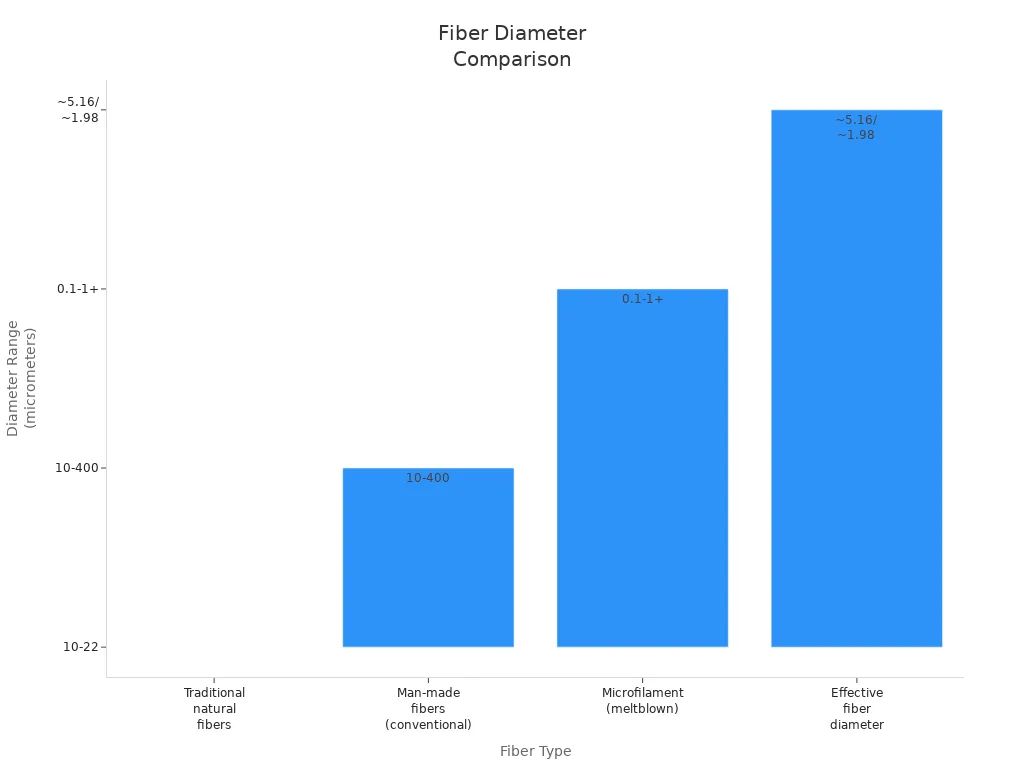
| Fiber Type | Diameter Range (micrometers) | Notes |
|---|---|---|
| Traditional natural fibers | 10 - 22 | Example: cotton fiber diameter |
| Man-made fibers (conventional) | 10 - 400 | Broad range depending on spinning technology |
| Microfilament (meltblown) | 0.1 - 1+ | Submicron to low micron range; significantly smaller than traditional nonwoven fibers |
| Effective fiber diameter (nonwoven fabric) | ~5.16 (effective), ~1.98 (SEM-equivalent) | Measured values for nonwoven fabrics including microfilament fibers |
Traditional Nonwoven: Standard Fiber Construction
Traditional nonwoven materials rely on fibers with much larger diameters, typically ranging from 10 to 400 micrometers. Manufacturers use several construction methods, including dry-laid, wet-laid, spunbond, and various bonding techniques.
- Dry-laid processes align fibers in parallel or random arrangements, then bond them using hot air or mechanical means.
- Wet-laid methods suspend fibers in water to form sheets, producing smooth, paper-like fabrics.
- Spunbond technology extrudes polymer filaments directly into webs, creating strong and uniform materials.
- Bonding methods such as needle punching, hydroentangling, thermal, and chemical bonding determine the final fabric’s strength, porosity, and functional properties.
| Construction Method | Description | Influence on Product Performance |
|---|---|---|
| Dry-Laid | Fibers are opened, blended, carded, and laid to form a lightweight, airy web with specific fiber orientation. | Provides uniformity and flexibility in fiber selection; results in products used in hygiene, filtration, and insulation with moderate production cost and strength. |
| Wet-Laid | Fibers suspended in water to form a slurry, deposited on a screen, then dried; similar to papermaking. | Produces smooth, fine webs with paper-like qualities; suitable for medical textiles and wipes; requires high water use and precise equipment. |
| Spunbond | Polymer granules extruded into continuous filaments, laid directly into webs. | Yields strong, uniform, and durable materials; high production speed and cost-effective; limited to thermoplastic fibers; used in geotextiles and packaging. |
| Mechanical Bonding | Fibers interlocked physically, e.g., needle punching or hydroentangling. | Enhances fabric cohesion and durability; needle punching yields strong, dense fabrics for automotive and filtration; hydroentangling produces soft, textile-like fabrics for wipes and medical uses. |
| Thermal Bonding | Heat and pressure fuse thermoplastic fibers at contact points. | Creates lightweight, bonded fabrics with good strength; common in hygiene and packaging products. |
| Chemical Bonding | Adhesives or binders applied to secure fibers. | Provides fabric stability and specific functional properties like water resistance; used in upholstery, garment interlinings, and filters. |
Traditional nonwoven fabrics often display a random fiber arrangement, which influences absorbency, strength, and surface texture. Scanning electron microscopy confirms this random structure, contrasting with the more ordered arrangements found in woven textiles.
Structural Comparison
The structural differences between Microfilament N and traditional nonwoven materials drive their performance in cleaning and hygiene applications. Microfilament N’s ultra-fine fibers create a dense, high-surface-area network, enabling superior dirt and pathogen capture. In contrast, traditional nonwovens, with their thicker and more randomly arranged fibers, offer moderate absorbency and strength but lack the fine-scale uniformity of microfilament-based materials.
| Property | 30 µm Microfilament (Nonwoven) | 100 µm Microfilament (Woven) | 230 µm Microfilament (Woven) |
|---|---|---|---|
| Diameter | 30 µm | 100 µm | 230 µm |
| Tenacity at Break (cN/tex) | Highest (approx. double of 100/230 µm) | Lower but sufficient for weaving | Lower but sufficient for weaving |
| Young's Modulus (MPa) | Highest | Similar to 230 µm | Similar to 100 µm |
| Crystallinity (%) | Highest due to greater drawing and polymer chain orientation | Lower | Lower |
| Thermal Properties | Glass transition ~60 °C, melting ~165 °C (similar for all) | Same as 30 µm | Same as 30 µm |
| Processability | Nonwoven (could not be woven due to fineness) | Woven scaffold produced | Woven scaffold produced |
| Biological Performance | Tested biologically but not woven | Improved bone cell adhesion and proliferation | Improved bone cell adhesion and proliferation |
Microscopy studies further reveal that Microfilament N fibers often display ordered or helicoidal molecular alignment, while traditional nonwovens show a more uniform but random fiber distribution. This difference in fiber arrangement and surface morphology leads to distinct performance characteristics.
Microfilament N delivers higher tenacity, flexibility, and surface area, making it ideal for applications requiring superior cleaning, durability, and hygiene.
Cleaning and Hygiene Performance
Pathogen and Dirt Removal
Effective cleaning relies on the ability of a material to capture and retain both visible dirt and microscopic pathogens. Microfilament-based nonwoven fabrics, such as spunbond-meltblown-spunbonded (SMS) laminates, set a new standard in microbial barrier performance. Scientific studies show that these microfibrous layers block bacteria like Staphylococcus aureus and Escherichia coli more effectively than traditional woven cotton or polyester. Disposable nonwoven gowns made from these materials resist liquid and microbial strike-through, which enhances infection control in healthcare settings.
Microfiber wipes, which use ultra-fine fibers, can remove up to 99.9% of bacteria and viruses when paired with detergent. In comparison, traditional cloths achieve about 67% removal. The unique structure of microfilament materials traps and holds microscopic particles, including pathogens, instead of pushing them around. This design reduces the risk of cross-contamination by locking in germs. Microfiber Wipes also perform well with or without cleaning solutions, offering flexibility in both healthcare and general cleaning. Clinical guidelines recommend single-use microfiber wipes to prevent the spread of pathogens, highlighting their critical role in infection control.
Microfilament N delivers a significant advantage in pathogen removal, making it the preferred choice for environments where hygiene is paramount.
Absorbency and Surface Contact
Absorbency determines how much liquid a cleaning material can hold, which directly impacts its effectiveness in removing spills and residues. Laboratory tests compare various fabric types, including polyester and nylon/polyester blends, in both knit and woven constructions. Results show that microfilament nylon/polyester knit wipes demonstrate the highest sorption capacity among tested samples. These wipes outperform traditional woven nylon/polyester and standard polyester knits.
The superior absorbency of microfilament knits comes from their increased number of pores and gaps. This structure allows the material to draw in and retain more liquid. Fabric density, weight, and fiber arrangement all influence sorption capacity. Knit structures, especially those using microfilament blends, maximize absorbency by providing more surface area and capillary channels.
Enhanced absorbency and surface contact mean that microfilament-based wipes clean more efficiently, leaving fewer residues behind and reducing the need for repeated wiping.
Cleaning Effectiveness Comparison Table
The following table summarizes the cleaning performance differences between microfilament and traditional nonwoven materials:
| Feature | Microfilament Nonwoven (e.g., SMS, Microfiber) | Traditional Nonwoven (e.g., Spunbond, Woven Cotton) |
|---|---|---|
| Pathogen Removal Rate | Up to 99.9% | About 67% |
| Absorbency | Highest (more pores, higher sorption) | Moderate to low |
| Surface Contact | Excellent (ultra-fine fibers, dense network) | Good (coarser fibers, less uniform) |
| Cross-Contamination Risk | Low (traps and locks in microbes) | Higher (may spread germs) |
| Cleaning Solution Requirement | Effective with or without solution | Often requires solution for best results |
| Recommended Use | Healthcare, hygiene-critical, high-traffic | General cleaning, low-risk environments |
🧼 Microfilament N stands out for its superior cleaning and hygiene performance, especially in settings where pathogen control and absorbency are critical.
Cost-Effectiveness and Durability
Upfront Cost vs Long-Term Value
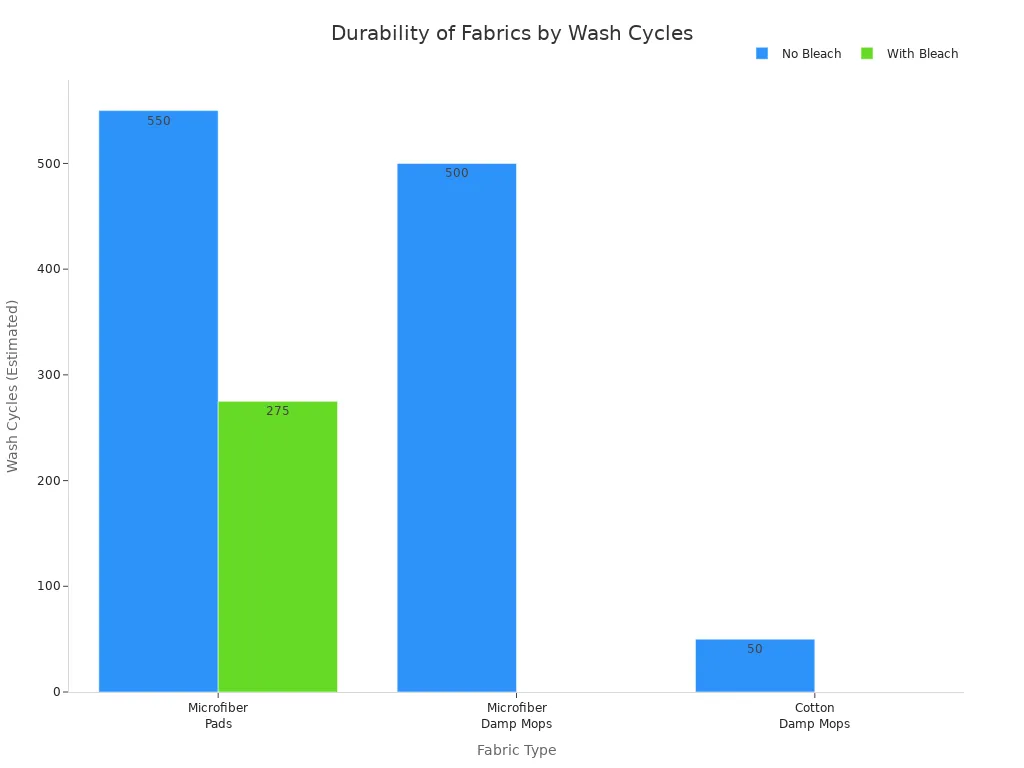
Microfilament N products often require a higher initial investment than traditional nonwoven materials. However, their extended lifespan and durability lead to significant long-term savings. Microfiber pads and damp mops can withstand hundreds of wash cycles, while cotton damp mops last for only about 50 cycles. This difference means users replace microfilament products far less frequently, reducing overall costs.
| Fabric Type | Wash Cycles Without Bleach | Wash Cycles With Bleach | Notes on Durability and Cost Impact |
|---|---|---|---|
| Microfiber Pads | 500 - 600 | 250 - 300 | Lasts 5-10 times longer than cotton, reducing replacement frequency and costs |
| Microfiber Damp Mops | ~500 | N/A | Significantly more durable than cotton damp mops, leading to cost savings |
| Cotton Damp Mops | ~50 | N/A | Much lower durability, requiring frequent replacement and higher long-term costs |
Reusability and Lifespan
Microfilament wipes, such as those made with Evolon or Asterion technology, show exceptional reusability. These wipes endure hundreds of wash cycles and resist fraying, even after repeated sterilization. Manufacturers use continuous filament technology, which eliminates the need for binders and edge stitching. As a result, microfilament N wipes outperform traditional nonwoven wipes, which are usually designed for single or limited use in institutional settings. This high reusability makes microfilament N the preferred choice for environments that demand both hygiene and cost control.
Maintenance Requirements
Proper care extends the life of both microfilament N and traditional nonwoven materials. Manufacturer guidelines recommend the following:
- Norafin's spunlace nonwovens withstand up to 100 washes while maintaining protective qualities.
- Freudenberg's comfortemp AIR fabrics remain durable and machine washable at 60°C, without clumping.
- comfortemp PROTECT products retain thermal insulation and durability after repeated laundering, making them suitable for protective workwear.
Regular washing at recommended temperatures helps preserve the performance and longevity of microfilament N products, supporting both hygiene and cost savings.
Environmental Impact of Microfilament N and Traditional Nonwoven
Waste Generation and Disposal
Both Microfilament N and traditional nonwoven materials contribute to waste streams in the textile and hygiene industries. Synthetic fibers, such as polypropylene and polyester, do not biodegrade quickly. These materials often persist in landfills for decades. Recycling post-consumer polypropylene remains a challenge due to impurities and degradation during processing. Advanced sorting and recycling technologies, including machine learning and spectroscopy, help improve the quality of recycled fibers. Melt spinning of recycled polypropylene enables the production of high-performance fibers, reducing waste and supporting a circular economy. However, most single-use nonwovens still end up as landfill waste, highlighting the need for better end-of-life solutions.
Chemical Use and Sustainability
Manufacturers use a range of chemicals and fibers in both Microfilament N and traditional nonwovens. Common materials include polyester, polypropylene, bicomponent fibers, and cellulosic fibers. Production processes often involve chemical modifications to enhance properties like absorbency and flame resistance. The textile industry accounts for about 20% of global pollution, mainly due to chemical use and high energy consumption. Recycling fibers, especially synthetic ones, reduces raw material demand and waste. Sustainable practices focus on using recycled PET, biopolymers like PLA, and certified renewable sources. Energy-saving methods, such as low melting point fibers, further improve sustainability. European directives encourage textile recovery and circular economy approaches to minimize environmental impact.
Eco-Friendly Alternatives
The industry now explores eco-friendly alternatives to traditional nonwovens. Sustainable options include organic cotton, hemp, bamboo, and Tencel. These materials use less water, fewer chemicals, and renewable resources. They also biodegrade faster and do not shed microplastics. The table below compares traditional and sustainable fabrics:
| Environmental Aspect | Traditional Fabrics (e.g., cotton, polyester) | Sustainable Fabrics (e.g., organic cotton, hemp, Tencel) |
|---|---|---|
| Resource Consumption | High water, petroleum-based | Lower water, renewable sources |
| Chemical Usage | Heavy pesticides, toxic dyes | Minimal, organic chemicals |
| Waste Generation | Non-biodegradable, persistent | Biodegradable, compostable |
| Microplastic Pollution | Yes | No |
| Carbon Footprint | High | Lower |
| End-of-Life Impact | Landfilled, persistent | Recycled, composted |
- The nonwoven sector shifts toward natural cellulose and recycled fibers.
- Collaboration across the supply chain drives innovation in sustainable materials.
- Challenges include higher costs and performance requirements, but market demand for green products continues to grow.
Sustainable nonwoven materials offer reduced resource depletion, pollution, and waste, making them a promising direction for the future.
Choosing the Best Material for Your Needs
When to Use Microfilament N
Microfilament N stands out in environments that demand high performance and strict hygiene. Facilities benefit from its advanced properties in several ways:
- Ultra-fine fibers penetrate microscopic crevices, capturing dirt, dust, and pathogens more effectively than traditional materials.
- The fabric adapts to rough or uneven surfaces, ensuring thorough cleaning.
- High absorbency allows it to hold up to 500% of its weight in liquid, while quick drying prevents bacterial growth.
- Lint-free construction makes it safe for sensitive surfaces such as glass, electronics, and stainless steel.
- Exceptional durability enables hundreds of wash cycles, reducing replacement frequency and supporting cost-effectiveness.
- Chemical and UV resistance make it suitable for demanding or outdoor environments.
- Microbial barrier properties and compliance with international standards ensure reliability in medical, food, and hygiene-critical applications.
Tip: Microfilament N is ideal for hospitals, laboratories, food processing, and any setting where superior cleaning and reusability matter.
When to Use Traditional Nonwoven
Traditional nonwoven materials remain valuable in specific scenarios:
- Single-use or disposable applications, such as surgical gowns, masks, and drapes, benefit from their sterility and fluid resistance.
- Hygiene products like diapers and sanitary pads rely on their absorbency and cost-effective production.
- Nonwoven laundry bags offer breathability, durability, and affordability for everyday use.
- Budget-conscious organizations choose traditional nonwovens for high-volume, short-term needs.
Healthcare facilities often select traditional nonwovens for disposable items that require sterility and easy replacement.
Quick Decision Guide
| Application Scenario | Recommended Material |
|---|---|
| Intensive, repeated cleaning | Microfilament N |
| Sensitive or delicate surfaces | Microfilament N |
| Single-use, sterile needs | Traditional Nonwoven |
| Budget or high-volume use | Traditional Nonwoven |
Choose Microfilament N for long-term value and superior hygiene. Select traditional nonwoven for disposable, cost-sensitive, or single-use applications.
Facilities seeking superior cleaning and long-term value often select Microfilament N. The table below shows reusable pads reduce waste by up to 97% and last 150–200 cycles, while disposable options offer faster cleaning but increase landfill waste.
| Aspect | Disposable Pads | Reusable Pads |
|---|---|---|
| Cleaning Effectiveness | Removes up to 99.99% of microbes | Strong cleaning, less consistent |
| Durability | Single-use, limited | 150–200 cycles, cost-effective |
| Environmental Impact | High waste, microplastic pollution | Reduces waste, laundering required |
Facilities should weigh cleaning needs, cost, and sustainability before choosing.
FAQ
What makes Microfilament N more effective for cleaning?
Microfilament N uses ultra-fine fibers that trap dirt and microbes more efficiently. This structure increases surface area and improves cleaning results in hygiene-critical environments.
Tip: Facilities seeking higher cleanliness should consider Microfilament N for best results.
Can traditional nonwoven materials be reused safely?
Most traditional nonwovens serve as single-use products. Reusing them may reduce effectiveness and increase contamination risk. Microfilament N offers better durability for repeated use.
Are microfilament products environmentally friendly?
Microfilament products last longer and reduce waste. Some use recycled fibers or biodegradable materials. Always check product labels for eco-friendly certifications.
- ♻️ Sustainable options help lower environmental impact.
