

 Send Email
 whatsapp



In a controlled environment, a mop is not just a cleaning accessory—it is a potential source of particles, fibers, chemical interference, and microbial risk. The wrong material can shed contaminants, absorb disinfectant actives, or fail under routine exposure to aggressive chemistries. The right tool, however, supports repeatable cleaning, validated disinfection, and compliance with ISO-class expectations. This guide explains how cleanroom mop materials, test standards, sorbency, particle generation, and chemical compatibility affect real-world performance. It also highlights where lab data is useful, where it has limits, and how facility teams can make a more defensible purchasing decision.
Why Cleanroom Mop Selection Matters
Contamination control in controlled environments relies heavily on the physical removal of particulate and microbial burdens. Selecting the right wiping and mopping tools is a critical operational decision; facility managers must evaluate substrate composition, particle generation rates, and chemical compatibility to maintain compliance with stringent industry standards.
Establishing an effective standard operating procedure begins with understanding the fundamental differences between commercial janitorial equipment and specialized contamination control tools.
Cleanroom Mops vs. Standard Industrial Mops
Standard industrial mops are engineered for heavy soil removal, typically utilizing cotton, rayon, or blended yarns. These materials rely on short staple fibers that break easily under mechanical stress, shedding tens of thousands of particles (≥0.5µm) per square meter and introducing unacceptable lint and bioburden into critical environments.
In contrast, a purpose-built cleanroom cleaning mop is manufactured using continuous filament yarns or heat-bonded synthetics. These controlled-environment tools shed a fraction of that amount—sometimes cited as fewer than 1,200 particles per square meter in controlled shaker tests—under identical stress. Furthermore, standard mops degrade rapidly when exposed to aggressive cleanroom disinfectants like sodium hypochlorite or accelerated hydrogen peroxide. Specialized mops maintain structural integrity and ensure the disinfectants reach the surface without their active ingredients being adsorbed or reacted with by the fabric.
Key Mop Head Materials and Performance Factors
The efficacy of a mop is dictated by its substrate material. Continuous filament knitted polyester is the industry standard for ultra-low particulate generation, making it suitable for the most stringent classifications. However, it offers moderate liquid retention. Microfiber, composed of polyester and polyamide split fibers, provides superior mechanical cleaning action. A high-quality cleanroom microfiber mop can physically remove up to 99.9% of surface microbes in specific manufacturer tests even before the application of biocides. However, it is important to note that such figures depend heavily on controlled test conditions—including organism type, surface material, and contact time—and do not guarantee real-world disinfection efficacy.
Furthermore, while standard metrics provide baseline particle counts, they do not always reflect in-use generation caused by floor abrasion, nor do they account for the varying surface friction and floor-drag of microfiber versus polyester during actual operator use.
The following table provides illustrative ranges for common materials; actual specifications and pass/fail thresholds will vary by supplier and testing methodology:
| Material Type | Particle Generation (≥0.5 µm/m² per IEST-RP-CC004.3) | Liquid Sorbency (mL/m² per IEST-RP-CC004.3) | Typical Application by ISO Class |
|---|---|---|---|
| Knitted Polyester | Ultra-Low (<1,000 counts) | Moderate (250 mL/m²) | ISO 3 to 5 |
| Microfiber Blend | Low (<2,500 counts) | High (400 mL/m²) | ISO 5 to 7 |
| Polyurethane Sponge | Low (<2,000 counts) | Very High (500 mL/m²) | ISO 6 to 8 |
Cleanroom Mop Standards and Validation
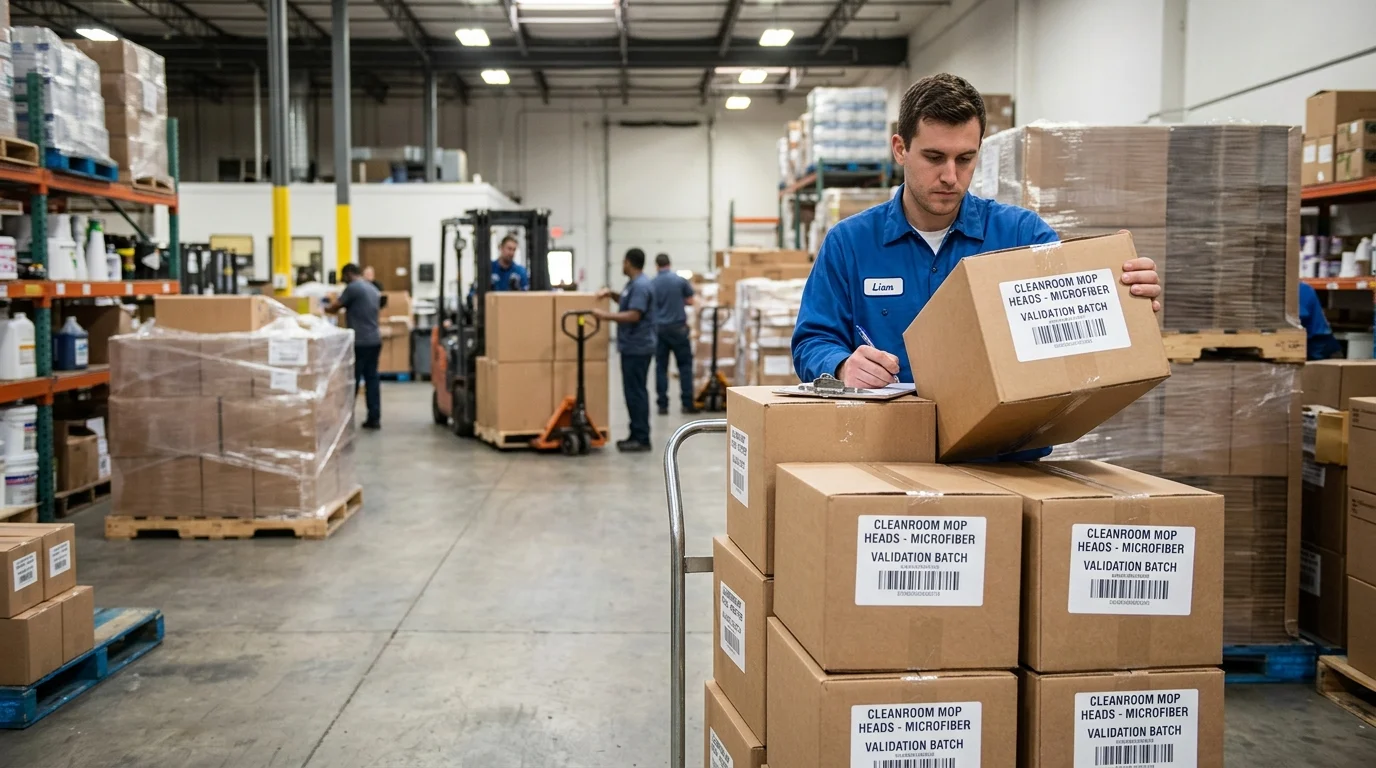
Procuring cleaning tools for regulated spaces requires strict adherence to international frameworks. Regulatory bodies mandate that all items introduced into clean spaces, including maintenance equipment, must not compromise the validated state of the room.
To ensure compliance, quality assurance teams must rely on standardized testing protocols and empirical data rather than marketing claims when evaluating floor and wall cleaning systems. Evaluating floor mops—which often require high sorbency for heavy liquid application—differs from selecting wall and ceiling cleaning systems, which prioritize lightweight frames and drip-free substrates.
ISO Class, GMP Grade, and USP Compounding Requirements
Different regulatory frameworks dictate specific mop characteristics. While ISO 14644-1 defines air cleanliness classifications rather than mandating specific mop materials, maintaining an ISO Class 3 or 4 environment requires ultra-low linting materials. In pharmaceutical manufacturing, EU GMP Annex 1 stipulates that cleaning equipment used in Grade A and B zones must be sterilized prior to use, making autoclavable or gamma-irradiated pre-sterilized mops mandatory. It is important to note that autoclavability depends on the full assembly. Hidden components such as adhesives, thread-locking compounds, gaskets, and plastic rollers can fail during steam sterilization, meaning the entire unit—not just the handle or Mop Head—must be validated for specific cycle parameters.
In compounding pharmacies, USP chapter <797> outlines strict cleaning frequencies, while USP <800> introduces mandates for handling hazardous drugs. USP <800> requires that cleaning tools used in hazardous compounding areas be dedicated to those spaces and deactivated, decontaminated, and cleaned using specific chemical sequences. To prevent cross-contamination, facilities operating under USP <800> often implement strict single-use disposable mop protocols in their negative pressure suites.
Test Data to Compare Cleanroom Mops
Objective comparison of cleaning tools requires reviewing the manufacturer's technical data sheets based on standard testing methods, such as IEST-RP-CC004.3. This standard outlines procedures for evaluating wipes and mops for particle generation, extractables, and sorbency.
When evaluating a cleanroom floor mop, engineers should look for results from rotary shaker or similar liquid-immersion tests (as outlined in IEST-RP-CC004.3), rather than dry-test methods like the Helmke Drum, which are intended for garments. Sorbency capacity is another critical metric; as a hypothetical benchmark, a high-grade mop head might exhibit a capacity exceeding 350 mL/m² to ensure efficient disinfectant application. Additionally, Non-Volatile Residue (NVR) tests might target extractable limits of less than 0.05 g/m² in deionized water, ensuring the mop does not leave a chemical film. Because particle generation, sorbency, and NVR limits vary by material lot and supplier, buyers should always verify these metrics through proper documentation during the procurement phase.
How to Choose and Source Cleanroom Mops
Developing a procurement strategy for facility maintenance tools involves balancing ergonomic requirements, sterilization capabilities, and the total cost of ownership. Establishing a standardized specification prevents inconsistent purchasing and ensures lot-to-lot reliability.
Partnering with a cleanroom mop supplier that maintains robust quality management systems—such as ISO 9001 certification—helps ensure that materials undergo rigorous quality control. This is the ideal stage to secure lot-specific Certificates of Analysis (CoA) and validated sterilization documentation, consolidating all necessary compliance paperwork required by facility auditors in one streamlined procurement step.
Quick Decision Matrix: Mop Selection by Classification
| Environment / Classification | Recommended Material | Sterilization / Sanitization |
|---|
Key Takeaways
- Avoid cotton, rayon, and blended industrial mops in cleanrooms because short staple fibers can shed unacceptable lint and particulate under mechanical stress.
- Select continuous filament knitted polyester for ISO 3 to ISO 5 areas when ultra-low particle generation is the top priority.
- Choose microfiber for ISO 5 to ISO 7 spaces when higher sorbency and stronger mechanical removal are needed, but validate results against your surfaces and SOPs.
- Compare cleanroom mop data using recognized methods such as IEST-RP-CC004.3 for particle generation and liquid sorbency rather than relying only on supplier claims.
- Confirm compatibility with disinfectants such as sodium hypochlorite and accelerated hydrogen peroxide before approving a mop for routine use.
- Include in-use factors such as floor abrasion, drag, operator fatigue, and wetting performance in mop qualification, not just laboratory particle counts.
Frequently Asked Questions
Why can’t standard industrial mops be used in cleanrooms?
Standard cotton, rayon, or blended mops use short staple fibers that can shed high levels of lint and particles. They may also degrade or react when exposed to cleanroom disinfectants such as sodium hypochlorite or accelerated hydrogen peroxide.
Which mop material is best for ISO 3 to ISO 5 cleanrooms?
Continuous filament knitted polyester is commonly preferred for ISO 3 to ISO 5 areas because it offers ultra-low particle generation, often below 1,000 counts in controlled test conditions.
When should a cleanroom microfiber mop be selected?
Microfiber is useful where mechanical soil and microbe removal are priorities. It typically offers higher sorbency than polyester and can support ISO 5 to ISO 7 cleaning programs, but performance should be validated under actual site conditions.
What standards are used to compare cleanroom mop performance?
IEST-RP-CC004.3 is commonly referenced for evaluating particle generation and liquid sorbency. Buyers should compare supplier test data, methods, and pass/fail limits rather than relying on material names alone.
Do low-particle mops guarantee disinfection?
No. Low particle generation supports contamination control, but disinfection depends on the disinfectant, surface, contact time, organism, mop technique, and validation results.