

 Send Email
 whatsapp


Infection control and cleaning consistency are no longer concerns limited to hospitals; they now shape decisions in cleanrooms, laboratories, manufacturing sites, and high-traffic commercial facilities. Single-use microfiber mop padsoffer a practical way to standardize each cleaning pass with a fresh textile, reducing the risks tied to laundering, residue carryover, and room-to-room contamination. But not all Disposable Pads perform the same. Fiber type, GSM, construction method, absorbency, and disinfectant compatibility all influence real-world results. This guide explains how these pads work, where they deliver the most value, and what specifications procurement teams should compare before choosing a product.
Why Choose Microfiber Disposable Mop Pads
The shift toward single-use microfiber solutions represents an evolution in infection control and facility maintenance. Unlike traditional string mops or standard cotton flats, these engineered nonwoven textiles offer precise liquid capacity and reliable particulate capture. Facility managers and environmental services (EVS) directors frequently use these single-use solutions to mitigate the cross-contamination risks inherent in laundering reusable textiles. By using advanced synthetic fibers, facilities can standardize their cleaning protocols, ensuring that every room is serviced with a fresh, uncontaminated tool.
Key Benefits for Commercial Cleaning
The primary advantage of single-use microfiber lies in its consistent mechanical cleaning efficacy. To understand this benefit, it is crucial to distinguish true split-filament microfiber from conventional cellulose, viscose, or wood-pulp nonwoven blends. Genuine split-filament mechanical capture behaves very differently from standard disposable nonwoven absorbency, actively trapping microscopic debris. When utilizing true split-fiber construction with proper moisture levels, these damp pads can effectively reduce surface bacteria and spores through mechanical action. However, validated spore reduction requires specific test protocols and compatible disinfectants. Furthermore, eliminating the laundering process bypasses the hidden lifecycle costs of reusable systems—specifically water, energy, commercial detergent, validation testing, and labor. Facilities often report notable reductions in chemical usage while saving custodial staff time that would otherwise be spent transporting, sorting, and managing soiled reusable inventory.
Best Use Cases and Environments
High-risk environments demand stringent hygiene protocols where cross-contamination carries severe operational, financial, or health consequences. Consequently, specialized disposable pads are frequently used in operating rooms, intensive care units, and isolation wards where hospital-acquired infections (HAIs) must be closely managed. Beyond healthcare, ISO Class 5 to Class 7 cleanrooms in pharmaceutical manufacturing and semiconductor fabrication rely on these non-linting pads to maintain low particulate counts. The single-use nature ensures that every cleaning cycle begins with a fresh pad, significantly reducing the risk of quat-binding—a phenomenon where quaternary ammonium disinfectants are neutralized when they bind to absorbent fabrics broadly, including fresh cotton and certain reusable microfibers.
How to Compare Materials and Specifications
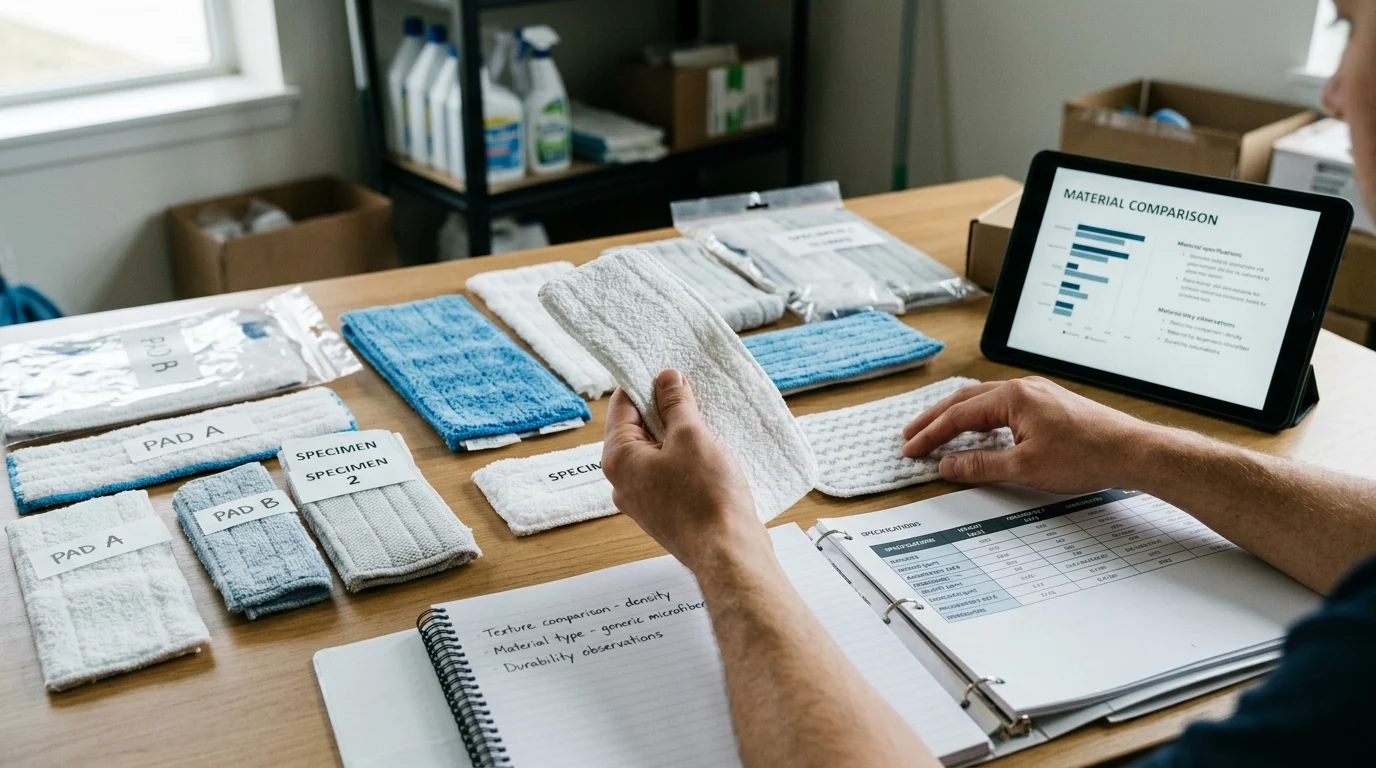
Evaluating nonwoven flat mop pads requires an understanding of textile engineering and nonwoven manufacturing processes, such as spunlace technology. Procurement teams must look beyond superficial dimensions to assess the structural integrity, absorption capacity, and fiber composition that dictate field performance and compatibility with existing hardware.
Essential Nonwoven Microfiber Specifications
The foundation of a high-performance disposable pad is its basis weight, measured in grams per square meter (GSM). While specifications vary by manufacturer, commercial-grade nonwoven pads often range from approximately 40 GSM for light dusting applications to 80 GSM for heavy-duty damp mopping and fluid spill management. The fiber blend is equally critical. Most standard disposable nonwoven spunlace pads consist of polyester/viscose or wood-pulp blends, which primarily offer absorbency rather than mechanical scrubbing. While an 80% polyester and 20% polyamide ratio is a standard specification for woven reusable cloths, some manufacturers market premium disposable pads claiming similar blends. Technically literate buyers should verify whether these are true split-fiber constructions or simply synthetic blends, as traditional spunlace rarely replicates the capillary action of woven polyamide. Additionally, buyers must verify the pad's liquid absorbency capacity. A premium 18-inch pad can often absorb multiple times its dry weight, holding sufficient disinfectant to provide continuous wet coverage for a standard patient room without requiring a mid-task replacement.
Disposable vs Reusable Mop Pad Comparison
When analyzing the lifecycle and efficacy of single-use versus launderable systems, operational needs often favor disposables in contamination-sensitive sectors. The following table outlines the fundamental differences between the two options based on standard commercial metrics:
| Specification / Metric | Disposable Microfiber Pads | Reusable Microfiber Pads |
|---|---|---|
| Typical Basis Weight | ~40 - 80 GSM (varies by brand) | ~250 - 450 GSM |
| Cross-Contamination Risk | Minimized (Single-use) | Variable (depends on laundering protocols) |
| Quat-Binding Risk | Minimal for synthetics (cellulose blends may vary) | Higher for cotton; mitigated in advanced synthetics |
| Microbe Removal Efficacy | High initial efficacy | Maintained with validated commercial laundering |
This comparative data highlights that while reusables possess a heavier initial build, the comprehensive lifecycle cost analysis—factoring in the previously mentioned laundering utilities and labor—can make single-use pads economically viable in certain regions. However, facility managers must carefully weigh these operational advantages against environmental sustainability trade-offs. Single-use pads generate a continuous waste stream and contribute to plastic pollution. Facilities in regions with strict environmental regulations are increasingly exploring biodegradable nonwoven alternatives to mitigate this impact, though validated certifications for these materials remain scarce. For critical cleaning supplies, the consistent performance of a disposable pad must be balanced against the multi-use lifespan of a launderable alternative.
How to Source and Implement the Right Mop Pads
Transitioning a facility's janitorial program to a single-use model necessitates rigorous supplier vetting and product validation. Strategic sourcing of custom-manufactured pads ensures that the final product aligns perfectly with existing frame hardware, chemical protocols, and specific environmental compliance standards, including color-coding requirements for different facility zones.
Sampling and Supplier Evaluation Steps
The evaluation process must begin with controlled field sampling and objective performance testing. Procurement officers should request batch samples to test dimensional stability, backing adhesion (typically hook-and-loop compatibility), and tensile strength during active use. Facilities often use ATP (Adenosine Triphosphate) testing before and after mopping to verify cleaning efficacy. It is important to note that ATP measures general organic residue rather than specific bacterial loads or spore elimination, and acceptable post-cleaning benchmarks will vary based on facility protocols and surface types. When vetting manufacturers, minimum order quantities (MOQs) and lead times are important but negotiable operational metrics. While some large-scale production runs for custom-branded pads might suggest MOQs of 50,000 to 100,000 units, these figures do not represent a fixed industry standard; they are highly supplier-specific and can often be tailored to a facility's storage capacity.
Key Takeaways
- Use true split-filament microfiber when mechanical capture of fine debris is more important than simple absorbency.
- Match pad weight to the task, with about 40 GSM suited to light dusting and around 80 GSM better for heavier damp mopping or fluid pickup.
- Deploy single-use pads in operating rooms, ICUs, isolation areas, and ISO Class 5 to Class 7 cleanrooms to reduce cross-contamination risk.
- Evaluate fiber composition, spunlace structure, absorption capacity, and hardware compatibility before selecting a disposable flat mop pad.
- Account for laundering, water, energy, detergent, validation, transport, and labor costs when comparing disposable and reusable mop systems.
- Confirm disinfectant compatibility to avoid issues such as quat-binding and to support validated cleaning outcomes.
Frequently Asked Questions
What makes split-filament microfiber different from standard disposable nonwovens?
True split-filament microfiber mechanically captures fine debris and microorganisms, while many cellulose, viscose, or wood-pulp nonwovens mainly provide absorbency. This difference affects cleaning performance, not just liquid pickup.
Where are disposable microfiber mop pads most useful?
They are especially useful in high-risk areas such as operating rooms, ICUs, isolation wards, pharmaceutical cleanrooms, and semiconductor facilities where cross-contamination or particulate control is critical.
What GSM range is common for commercial disposable mop pads?
Commercial nonwoven pads often range from about 40 GSM for light dusting to around 80 GSM for heavier damp mopping and fluid management. The right choice depends on soil load and task type.
Do disposable microfiber pads eliminate the need for disinfectants?
No. Damp microfiber can support mechanical soil and microbe removal, but validated pathogen or spore reductio n requires appropriate disinfectants, dwell times, and test-based cleaning protocols.
Can single-use pads reduce cross-contamination risk?
Yes. Using a fresh pad for each room or defined cleaning area reduces the chance of transferring soils, microbes, or residues from one surface or zone to another.