

 Send Email
 whatsapp


Floors may not be the first surface people associate with infection prevention, but in healthcare and high-traffic facilities they can contribute to environmental contamination when cleaning tools are reused improperly. Microfiber disposable mop pads address that risk by combining strong mechanical soil removal with a single-use workflow that limits the movement of microbes from one area to another. This article explains how microfiber structure improves pathogen capture, why disposable formats can support compliance, and what decision-makers should consider when comparing performance, cost, labor, and disinfectant compatibility. For facilities under pressure to standardize cleaning outcomes, the right mop pad is more than a supply item—it is part of the infection control system.
Why Microfiber Disposable Mop Pads Matter for Infection Control
Healthcare facilities increasingly recognize floor hygiene as a critical vector in environmental contamination. While validated commercial laundering protocols for Reusable Mops are effective when strictly followed, they can sometimes fall short of stringent standards in practice, leaving a vulnerability in terminal cleaning where up to 20% to 30% of surfaces may fail ATP (adenosine triphosphate) testing.
A robust alternative—or addition to a hybrid system—has emerged in single-use cleaning textiles designed to minimize the chain of infection at ground level. By transitioning to disposable systems, facilities can standardize floor care while maintaining rigorous hygiene compliance.
What Defines a Microfiber Disposable Mop Pad
A true microfiber disposable mop pad is engineered from synthetic fibers, typically a precise blend of polyester and polyamide. To qualify as microfiber, the individual textile fibers must be finer than 1.0 denier (typically measuring 3 to 5 micrometers in diameter, or roughly 1/100th the thickness of a human hair). Premium disposable pads often utilize ultra-fine fibers to maximize surface engagement.
This microscopic structure creates a massive surface area with millions of tiny hooks and crevices capable of mechanically trapping up to 99.9% of dirt, spores, and pathogens without relying solely on aggressive chemical disinfectants. Unlike standard cotton or basic non-woven synthetic pads, split microfiber generates a static electric charge when moved across dry surfaces, drawing in fine dust, while exhibiting superior capillary action during wet applications.
How Microfiber Disposable Pads Reduce Cross-Contamination
The primary advantage of these pads is the significant reduction of cross-contamination risks inherent in reusable systems. Infection control guidelines from organizations like the CDC highlight that improperly laundered reusable mops can retain up to 20% of their bacterial load, effectively redistributing resilient pathogens like Clostridioides difficile (C. diff) and Methicillin-resistant Staphylococcus aureus (MRSA) across different rooms.
By implementing a single-use protocol, cleaning staff ensure that a fresh, uncontaminated surface is introduced to every new space. Furthermore, disposable pads bypass the risk of "quat binding," a phenomenon where the positive charge of quaternary ammonium disinfectants neutralizes upon contact with certain reusable textiles, degrading the chemical's efficacy (often dropping active parts-per-million [ppm] by 40% to 50% within 10 minutes). High-quality disposable alternatives mechanically remove 99% to 99.9% of surface microbes, providing a highly reliable baseline for modern infection control.
How to Compare Microfiber Disposable Mop Pads
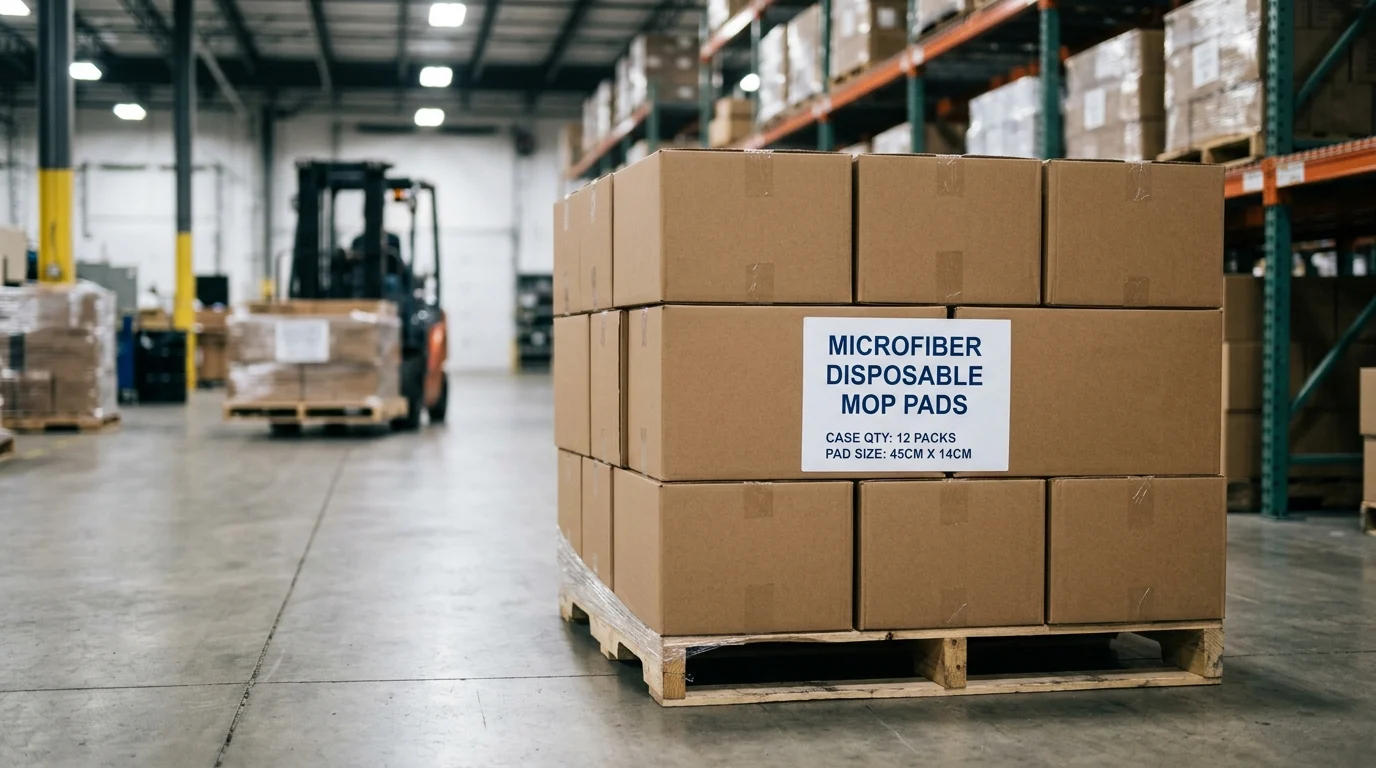
Transitioning to a single-use floor care system requires a comprehensive evaluation of available products. Decision-makers must look beyond the initial unit price to understand the total cost of ownership, operational efficiency, environmental impact, and the direct effect on facility-wide compliance metrics.
Performance, Cost, Labor, and Compliance Factors
When evaluating disposable cleaning mop pads, administrators must weigh material performance against labor, logistics, and sustainability. While the upfront unit cost of a disposable pad is generally low (typically $0.20 to $0.60 per pad), the hidden costs of reusable mops—including water, chemical detergents, energy, commercial laundry equipment maintenance, and labor—can push their true cost-per-use higher (often exceeding $0.40 to $0.75 per cycle when factoring in $5 to $10 initial replacement costs and $0.30+ per wash).
However, facilities must also account for the environmental trade-offs of single-use textiles. Disposables generate a continuous material waste stream that increases landfill contributions, and the disposal of synthetic textiles presents a major environmental concern regarding microplastic pollution. To balance sustainability goals with infection prevention mandates, facilities should explore life-cycle assessments, recycling programs, or biodegradable options where available.
| Evaluation Metric | Reusable Microfiber Mop | Disposable Microfiber Pad |
|---|---|---|
| Cross-Contamination Risk | Moderate to High (can retain ~20% bio-load) | Minimized (single-use per room) |
| Chemical Efficacy | Quat binding reduces active ppm by up to 50% | High compatibility, >95% active ppm retention |
| Labor Requirement | High (collection, washing, drying, sorting) | Low (attach, mop, discard) |
| Average Cost Per Use | $0.40 - $0.75+ (includes laundry overhead) | $0.20 - $0.60 (direct unit cost) |
| Water Usage per Cycle | 1.5 - 2.0 gallons (commercial laundry) | 0 gallons (no laundering required) |
Beyond direct financial considerations, disposables streamline compliance workflows. Safety audits become simpler when tracking inventory usage and standard operating procedures, rather than reviewing complex laundry temperature logs. Furthermore, fully saturated reusable mops are significantly heavier (often weighing 2 to 3 lbs), leading to increased physical fatigue and potential ergonomic strain for cleaning staff, whereas a saturated disposable pad typically weighs under 0.5 lbs.
Best-Use Areas in Healthcare and High-Risk Facilities
The deployment of these pads is highly strategic. They are essential in critical care environments such as operating theaters, intensive care units (ICUs), isolation wards, and pharmacy cleanrooms, where the threshold for healthcare-associated infections (HAIs) must be strictly minimized.
In these high-risk zones, standard protocols dictate that one pad covers a tightly defined square footage (typically 200 to 250 square feet) before it must be discarded. Used pads are typically classified as general waste in standard patient areas, but must be discarded as regulated medical waste if used in specific infectious isolation contexts or for large biohazard spills. By restricting usage to a single patient room, facilities create a definitive physical barrier that prevents the migration of multidrug-resistant organisms between vulnerable patient populations. Even within a single room, a pad must be swapped if it becomes fully saturated or heavily soiled before the cleaning cycle is complete. It is important to note that while single-use pads drastically reduce risk, mop frames, gloves, and improper mopping techniques can still transfer pathogens, meaning the risk is minimized rather than entirely eliminated.
How to Select and Implement the Right Mop Pad
Selecting the appropriate product requires rigorous supplier vetting and clear internal protocols. Even the highest-grade microfiber will fail to deliver optimal infection control if procured without consistent specifications or utilized incorrectly by the custodial staff.
Key Specifications and Supplier Controls
Procurement teams should mandate strict technical specifications when sourcing microfiber disposable mop pads.
Key Takeaways
- Use a fresh microfiber disposable mop pad for each room or defined cleaning zone to reduce cross-contamination risk.
- Choose pads made with fibers finer than 1.0 denier to improve soil, dust, and microbial capture.
- Evaluate total cost per use, not just pad price, because reusable systems add laundry, water, energy, chemical, and labor costs.
- Verify disinfectant compatibility to avoid issues such as quat binding that can reduce active disinfectant concentration.
- Pair disposable mop pads with validated cleaning procedures, correct dwell times, and staff training for consistent infection control.
Frequently Asked Questions
How does a microfiber disposable mop pad reduce infection risk?
It uses ultra-fine fibers to mechanically trap soil, spores, and microbes, then is discarded after use. This helps prevent contaminated mop material from being reused in another room or area.
Why is microfiber more effective than standard cotton mop material?
Microfiber has fibers finer than 1.0 denier, creating a much larger contact surface. Its tiny hooks, crevices, static charge, and capillary action improve dust capture, liquid pickup, and microbial removal.
Can disposable mop pads help prevent cross-contamination between rooms?
Yes. A single-use protocol gives staff a fresh pad for each room or defined area, reducing the chance that pathogens such as C. diff or MRSA are transferred from one space to another.
Do microfiber disposable mop pads replace disinfectants?
No. They support disinfection by improving mechanical soil and microbe removal, but facilities should still follow approved disinfectant dwell times, concentrations, and infection control protocols.
What is quat binding and why does it matter?
Quat binding occurs when some textiles reduce the active concentration of quaternary ammonium disinfectants. This can lower disinfectant performance, making material compatibility an important factor when choosing mop pads.