

 Send Email
 whatsapp


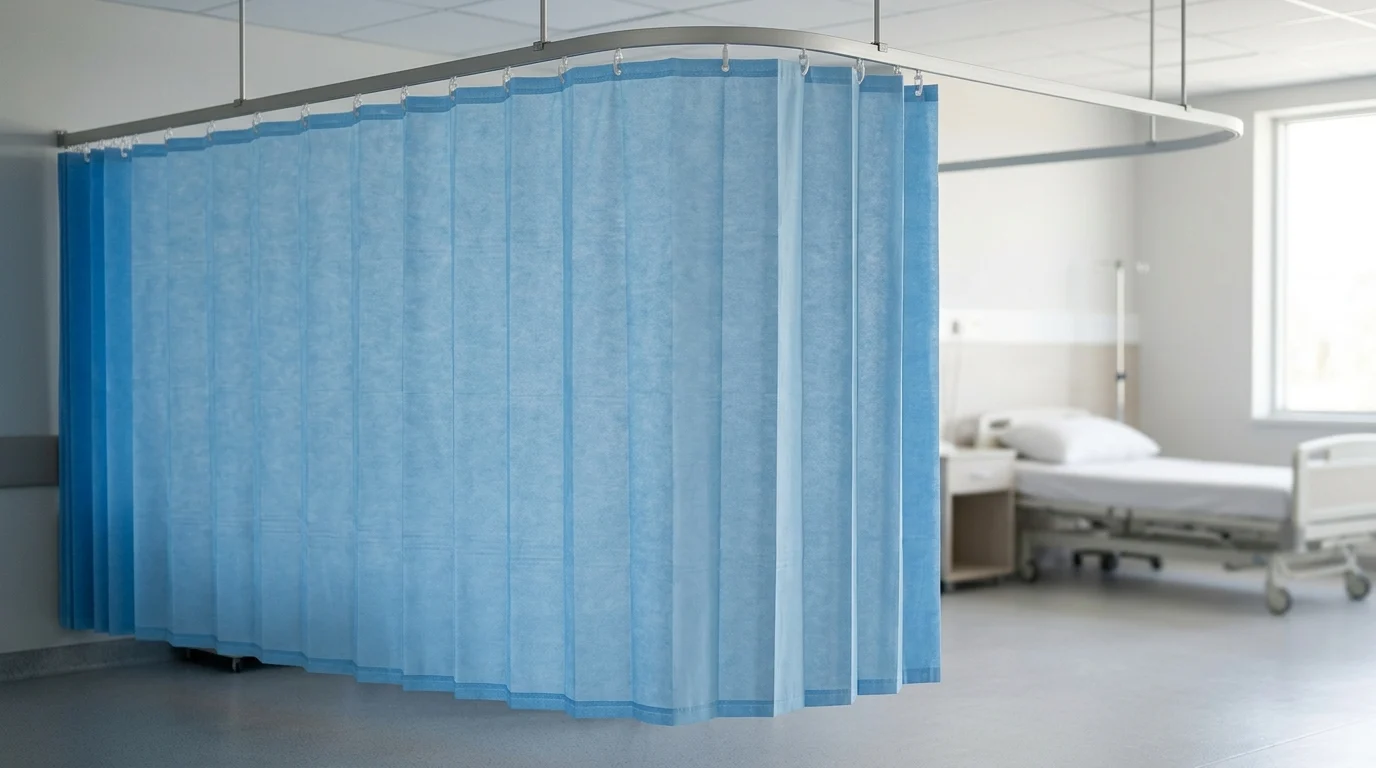
Privacy Curtains are easy to overlook, yet in busy wards they are touched often, changed inconsistently, and positioned close to vulnerable patients. That makes curtain selection more than a purchasing detail—it is an infection-control, workflow, and patient-dignity decision.Disposable hospital curtains can simplify changeovers and reduce laundering demands, but quality varies widely across materials, GSM levels, opacity, tear strength, and disposal implications. This article explains how premium single-use curtains differ from basic commodity options, which performance specifications matter most, and where facilities should balance hygiene gains against waste management, safety, and department-specific requirements.
Why High-Quality Disposable Hospital Curtains Matter
Healthcare facilities increasingly recognize that traditional privacy enclosures serve as highly touched, infrequently cleaned vectors for healthcare-associated infections (HAIs). Transitioning to Single-Use Hospital Curtains addresses this critical vulnerability by removing a known fomite from the patient environment. (Note that product availability and specific material specifications from individual suppliers may vary by region). However, the rapidly expanding market exhibits significant variance in manufacturing quality, requiring procurement teams to carefully distinguish between basic commodity barriers and reliable, purpose-built solutions. High-quality disposable hospital curtains provide tested performance that aligns seamlessly with stringent facility protocols and modern environmental mandates.
Key Benefits Beyond Single Use
The primary catalyst for adopting single-use formats is the elimination of complex laundering logistics. Traditional woven textiles require rigorous thermal disinfection protocols—often mandating sustained commercial wash cycles at 71°C—followed by costly transportation and labor-intensive re-hanging procedures. Premium disposable alternatives bypass this operational bottleneck entirely.
By utilizing non-woven synthetics (often categorized under recycling code 5 for polypropylene), top-tier products ensure that a clean, hygienic barrier is deployed for each new patient admission or isolation case. This immediate switch-out capability drastically mitigates cross-contamination risks while optimizing facility workflow. However, infection control committees must carefully weigh environmental and logistical trade-offs. While the material is technically recyclable, contaminated single-use curtains typically enter clinical waste streams, incurring specialized segregation costs or incineration fees. Furthermore, disposable options may be less suitable for psychiatric or bariatric settings that require higher abuse resistance and anti-ligature features.
Performance Specs That Define Premium Curtains
Distinguishing premium hospital curtains requires examining their foundational structural specifications. Lower-grade options often utilize thin materials that compromise patient privacy through excessive translucency and carry a high risk of tearing during routine ward activities.
In contrast, higher-quality variants are typically manufactured from dense, spunbond non-woven polypropylene. At this elevated density, the material achieves optimal visual opacity for patient dignity. Furthermore, premium grades offer superior tensile strength. This robust structural integrity ensures the curtain can withstand rapid handling during medical emergencies, sudden bed movements, and daily clinical operations without tearing or structural failure.
How to Compare Disposable Hospital Curtains
Selecting the appropriate barrier involves analyzing technical documentation and certified testing data from independent standards bodies rather than relying on superficial aesthetics or baseline pricing. Decision-makers must evaluate how different product tiers perform against established clinical, safety, and durability baselines. Implementing a standardized comparative approach ensures that the chosen disposable hospital curtains deliver both regulatory compliance and long-term economic value across various hospital departments.
Core Criteria for Product Comparison
When evaluating potential solutions, standardizing the comparison matrix is essential for uncovering hidden operational deficiencies. The following table highlights the operational differences across standard, mid-tier, and premium disposable partitions:
| Specification | Standard Disposable | Mid-Tier Options | Premium Clinical-Grade |
|---|---|---|---|
| Material Density | 70 - 80 GSM | 80 - 100 GSM | 100 - 120 GSM |
| Antimicrobial Tech* | Topical Spray | Mixed / Surface | Extrusion-Impregnated |
| Tear Resistance (Tensile) | < 30 N | 30 - 50 N | > 50 N (Mfr. reported) |
| Pleat Memory | None (Loses shape) | Partial retention | Heat-welded (Retains fold) |
| Track Compatibility | Fixed / Proprietary | Universal | Universal (U-Hook / Eyelet) |
*Note: Antimicrobial lifespan depends heavily on the specific active chemistry used and environmental factors within the ward, rather than product grade alone. Buyers should request independent validation of these conditional ranges.
By prioritizing advanced specifications, facilities avoid the hidden lifecycle costs associated with premature replacements, aesthetic degradation, and incompatible mounting hardware that delays installation.
Certifications, Fire Ratings, and Antimicrobial Claims
Regulatory compliance remains the most critical differentiator in the procurement process. Virgin polypropylene is inherently flammable. Therefore, claimed fire retardancy depends on additive treatments, which can degrade over time or with cleaning. High-quality products must provide certified fire retardancy that consistently meets stringent independent standards. These include NFPA 701 in the United States, AS 1530.2 in Australia, or BS 5867 Part 2 Type C in the United Kingdom. Procurement teams should request current, lot-specific test certificates rather than assuming blanket compliance based on polymer marketing. Disposable nonwovens sometimes fall under different national or state-level classifications than traditional textiles. Consequently, verifying which specific test method the local regulator mandates is essential before procurement.
Furthermore, premium options integrate silver-ion antimicrobial technology directly into the polymer extrusion process. This method is far more stable than topical sprays, which degrade quickly. When tested under independent protocols like ISO 20743 or AATCC 100, this engineered integration aims to provide a manufacturer-documented >99.9% reduction in common multi-drug resistant pathogens, including MRSA and VRE. This active biocidal property claims to maintain its efficacy for a validated duration in active clinical environments. However, silver-ion antimicrobial treatments are regulated as pesticides or treated articles. Examples include EPA/FIFRA in the United States or BPR in the European Union. Because of this, legal registration status must be verified in the specific jurisdiction. Finally, independent, peer-reviewed, or third-party audited validation should be demanded before accepting any manufacturer-sponsored efficacy benchmarks.
The successful deployment of Single-Use Medical Curtains extends far beyond the initial purchase order. Proper sourcing, standardized installation procedures, and rigorous supply chain management are required to realize the full clinical and financial benefits of the transition. A strategic, well-documented approach streamlines inventory management and establishes a unified, facility-wide infection control protocol that nursing staff can easily follow.
Evaluating Suppliers, Sizes, Hooks, and Formats
Purchasing departments must comprehensively assess supplier capabilities, particularly regarding dimensional standardizations, hardware flexibility, and production scalability. Manufacturers offer modular sizing systems, typically featuring standard drops of 2.0 meters with variable widths ranging from 2.5 meters to 7.5 meters to accommodate diverse spaces from standard bed bays to intensive care units.
Furthermore, supplier evaluation should carefully account for Minimum Order Quantities (MOQs), which generally range from 500 to 1,000 units for customized color-coding schemes or specific
Key Takeaways
- Compare disposable hospital curtains by verified specifications, not price alone, including GSM, opacity, tensile strength, and safety testing.
- Choose higher-density non-woven polypropylene curtains, often around 100–120 GSM, when patient privacy and tear resistance are priorities.
- Use disposable curtains to reduce laundering logistics, especially where reusable textiles require commercial thermal disinfection cycles such as 71°C washing.
- Plan waste handling before procurement because contaminated single-use curtains may require clinical waste segregation or incineration.
- Avoid using standard disposable curtains in psychiatric, bariatric, or high-abuse settings unless the product is designed for those risks.
Frequently Asked Questions
Why switch from reusable curtains to disposable hospital curtains?
Disposable hospital curtains reduce reliance on laundering, transport, and re-hanging workflows while allowing facilities to replace a privacy barrier quickly between admissions, discharges, or isolation cases.
What material is commonly used in premium disposable hospital curtains?
Many higher-quality options use dense spunbond non-woven polypropylene, often associated with recycling code 5, because it can provide opacity, strength, and practical handling in clinical settings.
What GSM range suggests a stronger disposable curtain?
Premium clinical-grade disposable curtains are often in the 100–120 GSM range, compared with standard options around 70–80 GSM and mid-tier options around 80–100 GSM.
Do disposable curtains eliminate infection-control concerns?
No. They can reduce cross-contamination risk by enabling rapid replacement, but facilities still need clear protocols for change frequency, handling, segregation, and disposal of contaminated curtains.
Are disposable hospital curtains recyclable?
Some polypropylene curtains may be technically recyclable, but once contaminated in clinical use they often enter regulated waste streams, which may involve segregation costs or incineration.