

 Send Email
 whatsapp


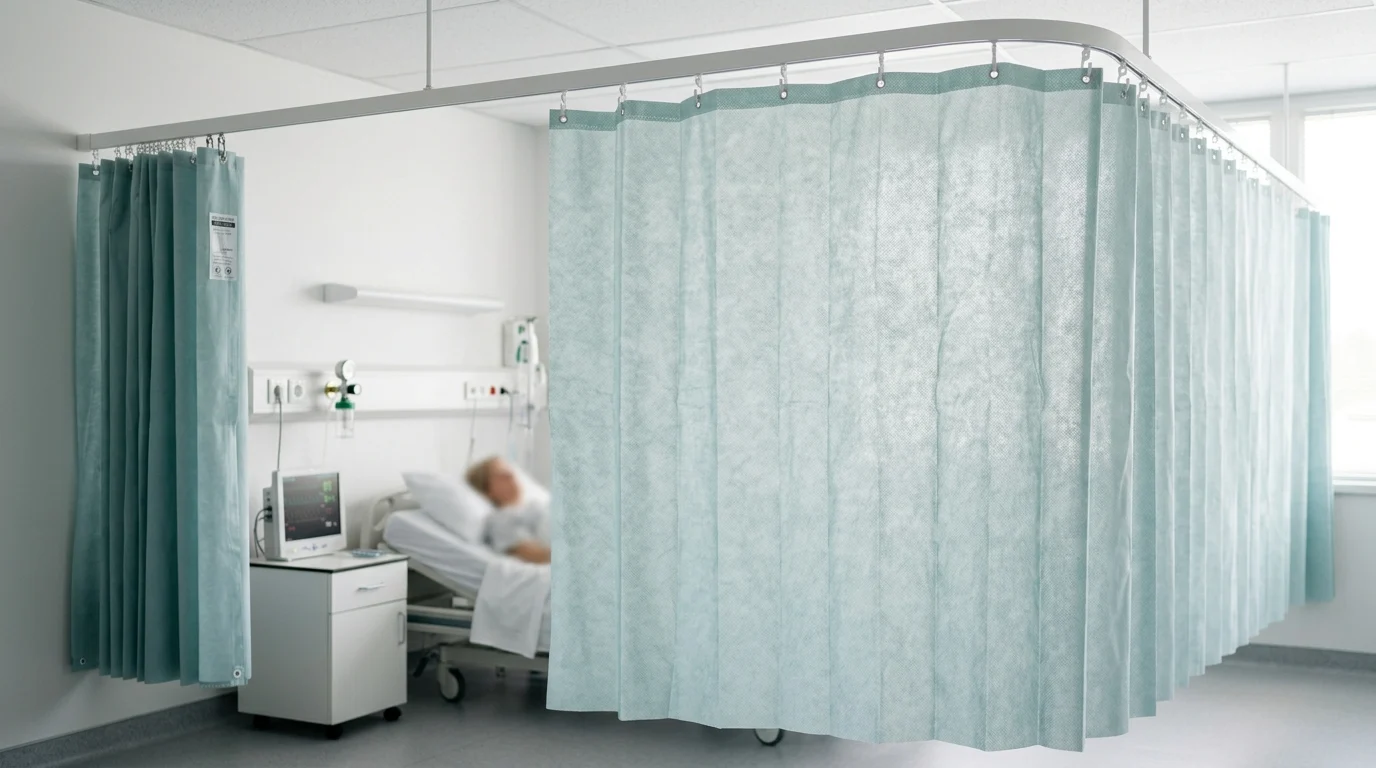
Disposable Privacy Curtains are more than a convenience purchase—they are part of a facility’s infection-control strategy. With healthcare-associated infections affecting about1 in 31 hospital patients on any given day, the fabric used between beds can influence hygiene, maintenance workload, and long-term cost. The two most common nonwoven options, standard spunbond polypropylene and SMS, share the same base polymer but perform differently because of how they are constructed. This article compares their barrier properties, durability, breathability, safety standards, and disposal considerations so procurement teams can select curtains that match clinical risk, patient comfort, and budget requirements.
Why Material Choice Matters for Disposable Hospital Curtains
The adoption of Single-Use Hospital Curtains is a critical strategy for mitigating healthcare-associated infections (HAIs). HAIs currently affect about 1 in 31 hospital patients daily. Traditional woven textiles require energy-intensive laundering above 71°C (160°F). This thermal disinfection rapidly degrades fabric integrity and incurs high logistical costs. Transitioning to nonwoven synthetics offers a predictable, disposable barrier. Note that "single-use" often means scheduled-replacement textiles (e.g., quarterly discard-and-replace) rather than single-patient-use items.
Selecting the optimal nonwoven polymer dictates the curtain's barrier efficacy, mechanical resilience, and total lifecycle cost. This cost of ownership must incorporate waste management. Post-use curtains are not automatically regulated medical waste. Classification depends on clinical contamination levels and local regulations. Facilities should verify local recycling streams, incineration allowances, or vendor take-back programs for polypropylene nonwovens, as disposal costs and permitted pathways vary significantly by jurisdiction.
Key Differences Between SMS and PP Nonwoven Materials
Both standard spunbond and Spunbond-Meltblown-Spunbond (SMS) architectures use the same base polymer: polypropylene (PP). The distinction lies in their construction. Standard PP curtains use a single or double layer of spunbond polypropylene fibers. These are typically manufactured between 100 and 120 grams per square meter (GSM) for opacity and strength. The spunbond process extrudes continuous filaments to create a highly breathable, durable web.
In contrast, SMS is a tri-laminate fabric. It sandwiches a high-density meltblown polypropylene layer between two structural spunbond layers. This meltblown layer contains microfibers (1 to 5 microns) capable of filtering sub-micron particles. This architecture grants SMS a significantly higher Bacterial Filtration Efficiency (BFE). While BFE is primarily a respiratory metric, it serves as an analogous barrier benchmark for curtains. However, the meltblown layer in SMS typically reduces air permeability compared to spunbond PP. Buyers should also note inherent nonwoven drawbacks beyond breathability: synthetic materials can generate static cling and produce noticeable noise or rustling when drawn, which may impact patient comfort in quiet wards.
Performance Criteria Buyers Should Compare
Procurement specialists must weigh several performance specifications beyond basic material composition. Evaluating these metrics ensures safety and durability:
- Flame Retardancy: A non-negotiable safety parameter. Both PP and SMS variants must achieve NFPA 701 or BS 5867 Part 2 Type C compliance, ensuring the material melts rather than propagates a flame.
- Fluid Resistance: Measured by standards like AATCC 127. SMS typically withstands higher liquid pressures due to its meltblown core.
- Tensile Strength vs. Tear Resistance: These are distinct mechanical properties. Tensile strength (measured via ASTM D5034) evaluates the force required to break the fabric, while tear resistance (measured via ASTM D5587) dictates how well curtains resist ripping at suspension eyelets during sudden pull forces.
Note that at an identical 100–120 GSM, SMS devotes part of its mass to the meltblown layer, which offers a low mechanical contribution. Therefore, a pure spunbond PP may offer comparable or superior tear resistance. Always request lot-specific test data rather than assuming SMS is structurally stronger.
SMS vs PP Nonwoven Curtains: Barrier, Durability, and Cost
Analyzing the functional and economic trade-offs between SMS and PP nonwovens requires comparing their barrier properties and unit costs. Both materials eliminate laundering logistics, but their manufacturing complexities dictate their market positioning.
| Feature/Metric | Spunbond PP (100-120 GSM) | SMS Tri-Laminate (100-120 GSM) |
|---|---|---|
| Bacterial Filtration (BFE) | Moderate | High (Note: Respiratory metric) |
| Fluid Resistance | Low to Moderate | High (e.g., AATCC 127) |
| Tensile & Tear Resistance | High | Comparable to PP (verify lot data) |
| Estimated Unit Cost Index | Base Cost | Premium (varies by supplier) |
| Optimal Clinical Setting | General Wards, Outpatient | ICU, Isolation, Burn Units |
When SMS Curtains Offer Better Protection
SMS nonwovens deliver excellent environmental isolation in high-acuity clinical zones. The integrated meltblown layer acts as a microscopic web. It physically traps aerosolized pathogens and prevents strike-through from bodily fluids or chemical splashes. Standards evaluating this resistance (like ASTM F1670/F1671) are designed for protective apparel but serve as analogous benchmarks for curtains. Consequently, SMS is the preferred specification for Intensive Care Units (ICUs), surgical recovery rooms, burn units, and infectious disease isolation wards. Facilities deploy SMS disposable curtainss](https://www.esunesun.com/disposable-cubicle-curtains-products/) in these environments to reduce surface contamination on surrounding medical equipment. This enhanced barrier lowers cross-contamination risks and the incidence of costly HAIs, justifying the unit cost premium.
When PP Curtains Provide Better Value
Conversely, 100% spunbond PP excels in high-turnover environments. These areas prioritize visual privacy and basic contact isolation over stringent fluid repellency. General medical-surgical wards, outpatient triage bays, emergency department overflow zones, and rehabilitation centers benefit from the robust opacity, breathability, and mechanical durability of PP. PP requires fewer manufacturing passes than a tri-laminate, resulting in a highly attractive lower price point. Large hospital networks often manage thousands of beds on a scheduled 3-to-6-month curtain replacement cycle. Standardizing on PP for these low-risk zones yields substantial annual procurement savings. This strategy stretches operational budgets without compromising baseline hygiene protocols.
How to Choose the Right Disposable Hospital Curtain
Strategic procurement of Disposable curtains requires balancing clinical efficacy against supply chain reliability and budgetary constraints. Healthcare administrators must implement rigorous vendor qualification protocols. This ensures consistent material quality, stable bulk pricing, and strict regulatory compliance across high-volume recurring orders.
Practical Sourcing Steps to Reduce Risk
Mitigating supply chain risk begins with auditing manufacturer credentials and manufacturing tolerances. Procurement specialists should focus on the following material-specific steps:
- Verify Meltblown Consistency: For SMS orders, demand quality control data proving the meltblown layer's consistency across different lots, as uneven distribution compromises barrier efficacy.
- Confirm Opacity Thresholds: When sourcing lightweight PP, establish minimum opacity requirements to ensure patient privacy is not compromised under bright clinical lighting.
- Demand Independent Testing: Require independent, third-party laboratory test reports for NFPA 701 flame retardancy tied directly to specific dye lots, rather than accepting generic historical certificates.
- Establish Defect Tolerances: Set acceptable defect rates for critical structural failures.
Key Takeaways
- Choose SMS curtains when higher fluid resistance and barrier performance are priorities, especially in areas with greater contamination risk.
- Consider standard spunbond PP curtains for general ward use where breathability, tear resistance, and cost control are more important.
- Request lot-specific test data for flame retardancy, fluid resistance, tensile strength, and tear resistance instead of relying on material labels alone.
- Compare curtains at the same GSM range, typically 100–120 GSM, because SMS and PP distribute material weight differently.
- Confirm local disposal rules and available recycling or take-back options before calculating the total lifecycle cost of disposable curtains.
Frequently Asked Questions
Are SMS and PP nonwoven curtains made from different plastics?
No. Both are typically made from polypropylene. The difference is structure: standard PP uses spunbond layers, while SMS adds a meltblown microfiber layer between spunbond layers for improved barrier performance.
Which material offers better fluid and bacterial barrier performance?
SMS generally provides better barrier performance because its meltblown core helps resist liquid penetration and improves filtration efficiency compared with standard spunbond PP.
Is SMS always stronger than standard PP nonwoven?
Not necessarily. At the same 100–120 GSM, SMS allocates some weight to the meltblown layer, which adds less mechanical strength. Spunbond PP may offer equal or better tear resistance in some curtain applications.
What standards should disposable hospital curtains meet?
Buyers should verify flame-retardancy compliance such as NFPA 701 or BS 5867 Part 2 Type C, plus relevant test data for fluid resistance, tensile strength, and tear resistance.
Do single-use hospital curtains mean one patient only?
Usually not. In many facilities, single-use means scheduled replacement, such as quarterly discard-and-replace, rather than changing the curtain after every patient.