

 Send Email
 whatsapp


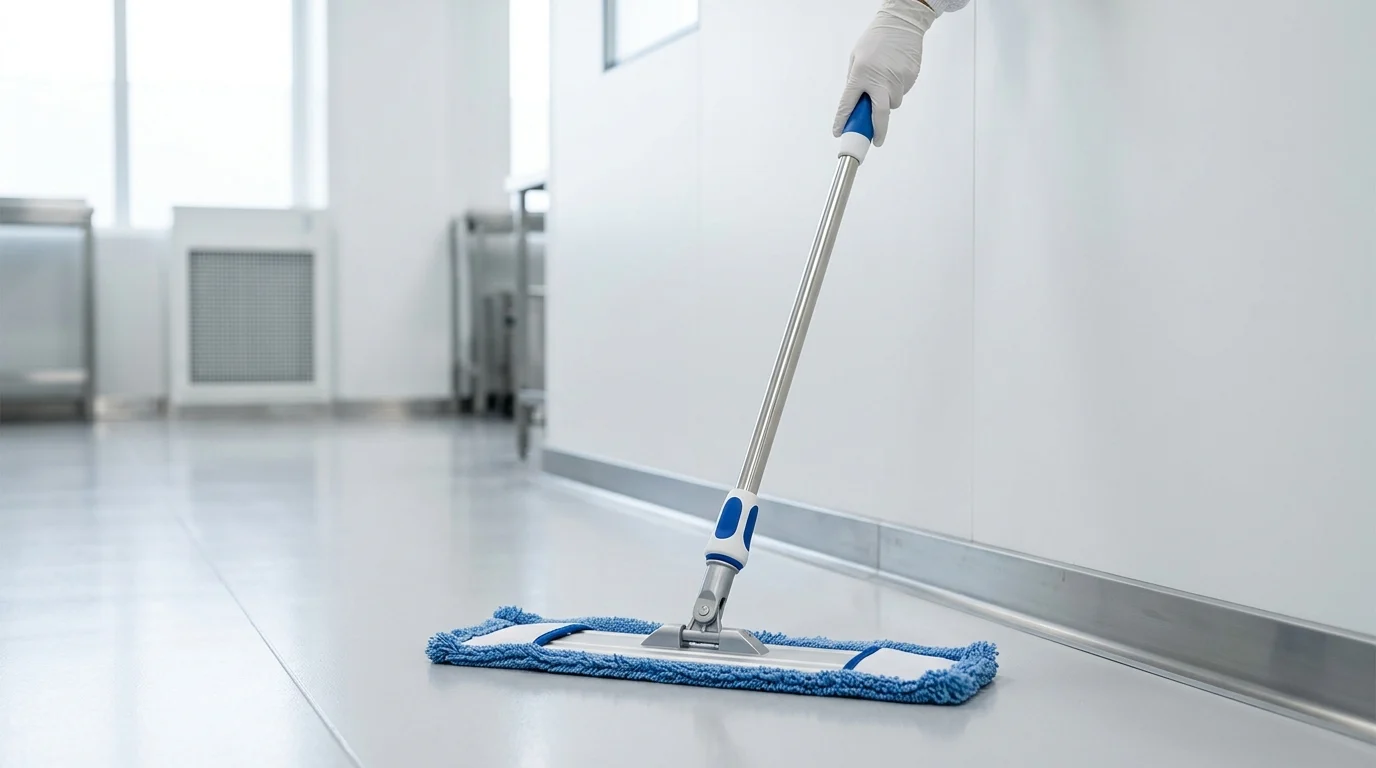
In critical manufacturing, contamination control is only as strong as the tools used to maintain it. A mop that looks clean can still release fibers, particles, ions, or residues capable of damaging wafers, compromising sterile drug production, or triggering audit findings. For facilities operating under ISO 14644 or EU GMP Annex 1 expectations, the choice of mopping system is not a routine purchasing decision; it is part of the contamination control strategy. This article explains how low-lint cleanroom mops differ from standard janitorial tools, what risks they help prevent, and which specifications facility teams should evaluate before selecting a disposable or reusable system.
Why Low-Lint Cleanroom Mops Matter
In critical manufacturing environments, such as semiconductor fabrication and biopharmaceutical compounding, stringent contamination control governs all operations. Selecting a low-lint cleanroom mop is a fundamental necessity for compliance. Facility managers must ensure that the tools designed to eliminate contaminants do not inadvertently become sources of particulate generation.
Maintaining an ISO Class 3 environment (per ISO 14644-1 standards) or an EU GMP Annex 1 Grade A zone requires cleaning implements engineered for near-zero shedding. It is vital to distinguish between ISO 14644 air cleanliness classes, typically used in microelectronics, and GMP grades, which govern pharmaceutical sterility. In both contexts, the use of inappropriate materials can compromise air quality, introduce microscopic defects onto silicon wafers, or violate the sterility of pharmaceutical batches, leading to costly yield losses and regulatory non-compliance.
Defining a Cleanroom Mop
A specialized cleanroom mopping system—defined as a controlled-environment cleaning tool engineered to minimize particulate generation—is structurally distinct from standard commercial janitorial equipment. Rather than utilizing spun yarns, cotton, or raw cellulose, which fracture and release short fibers upon abrasion, cleanroom-grade variants rely on continuous monofilament or multifilament synthetic textiles.
These engineered textiles undergo proprietary laundering processes in highly controlled environments prior to packaging. This rigorous pre-washing ensures that initial particulate loads and manufacturing residues are minimized before the product ever reaches the end-user facility, establishing a standard of cleanliness that standard industrial mops cannot achieve. It is also crucial to distinguish early on between single-use mops and reusable systems. Single-use mops are typically pre-sterilized via gamma irradiation and disposed of after a single use, whereas reusable systems are designed to withstand repeated laundering and autoclaving lifecycles. Choosing between them requires a procurement comparison that addresses total cost of ownership, waste disposal constraints, and differing validation requirements (e.g., gamma irradiation certificates versus in-house laundering validation).
Sources of Fibers, Particles, Ions, and Extractables
During routine surface disinfection, mechanical friction forces the mop substrate against flooring or walls, which can shear micro-fibers. Beyond physical shedding, chemical interactions pose severe risks. When exposed to harsh disinfectants, non-compliant materials can leach non-volatile residues (NVRs) and metallic ions into the cleaning solution. Furthermore, mop handles and frames must be evaluated as potential sources of contamination; materials like electropolished stainless steel or advanced polymer composites are required to prevent the shedding of particles and ions that common plastics or untreated metals might release.
In semiconductor manufacturing environments, the presence of sodium, chloride, or potassium ions exceeding strict thresholds—such as an illustrative limit of 0.5 parts per million (ppm)—can lead to catastrophic wafer defects, short circuits, and altered electrical properties. It is important to note that ionic thresholds vary significantly by semiconductor process node, making the 0.5 ppm figure strictly an illustrative example rather than a universal limit. Therefore, evaluating the extractable profile of the mop substrate in the presence of common solvents is just as critical as measuring its physical tensile strength and resistance to mechanical abrasion.
Key Cleanroom Mop Specifications
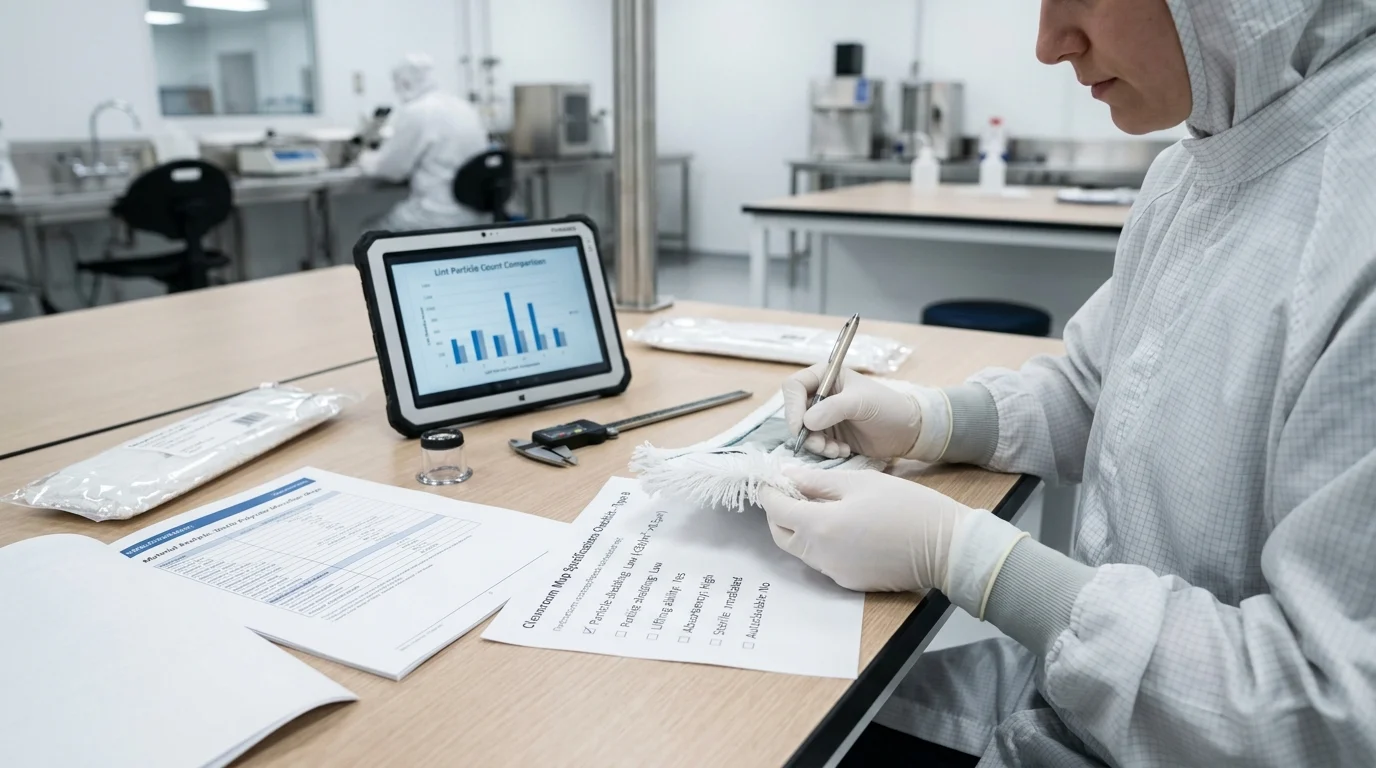
Engineering a mop for critical environments requires balancing mechanical durability with strict contamination control parameters. The technical specifications of the mop head dictate its suitability for specific ISO classes and determine how effectively it integrates into facility standard operating procedures (SOPs). Material selection depends heavily on specific process chemistry, disinfectant compatibility, and surface topography—not solely on the target ISO class.
Materials and Edge Designs
The substrate material and its construction are the primary drivers of mopping performance. Continuous filament polyester is the industry standard due to its high tensile strength and exceptionally low linting profile. To eliminate fiber release at the borders, a high-quality polyester mop features ultrasonically or laser-sealed edges, which melt the synthetic fibers into a continuous, fray-resistant boundary.
However, facilities must navigate a trade-off between ultra-low-lint properties and mechanical cleaning efficacy; the least-shedding materials may not always remove stubborn residues as effectively as blended fabrics. Blending polyester with nylon creates a microfiber composite, which offers superior mechanical lifting of microscopic contaminants but requires rigorous edge sealing to maintain ISO compliance. The choice between these materials depends heavily on the specific balance of absorbency, cleaning power, and particulate limits required by the facility.
| Material Type | Linting Profile | Absorbency Capacity (Illustrative)* | Chemical Resistance | Optimal Environment |
|---|---|---|---|---|
| 100% Continuous Polyester | Ultra-Low | Moderate (150-200%) | Excellent | ISO 3-5, Semiconductor |
| Polyester/Nylon Microfiber | Low | High (>300%) | Good | ISO 4-6, Pharmaceutical |
| Polyurethane Sponge** | Moderate | Very High (>400%) | Moderate | Grade C/D, Support Areas |
*Note: Absorbency percentages are illustrative examples; consult specific supplier datasheets for exact performance metrics.
**Note: Moderate-lint options like polyurethane sponges are incompatible with ISO 3–5 environments. Because ISO 6 remains a strictly controlled environment, these materials should be explicitly restricted to EU GMP Grade C/D or unclassified support areas.
Sterility, Chemical Compatibility, and Absorbency
For aseptic manufacturing, particularly in pharmaceutical and biotechnology sectors, the cleaning implement must not introduce bioburden. Single-use products utilized in these regulated zones are typically gamma-irradiated to achieve a Sterility Assurance Level (SAL) of 10^-6, accompanied by lot-specific certificates of irradiation to verify compliance.
Furthermore, the mop head must demonstrate robust chemical compatibility with alternating or rotating disinfectant regimens. It is critical to note that disinfectant degradation depends on concentration, temperature, and exposure duration, not just the material type. Because rotating disinfectants may require separate compatibility studies rather than assuming one substrate suits all chemistries, facilities must verify resistance when exposed to agents like 70/30 isopropyl alcohol (IPA), sodium hypochlorite (bleach), and quaternary ammonium compounds. Premium substrates are engineered to retain high volumes of fluid (often exceeding an illustrative 300% of their dry weight), ensuring even distribution of disinfectants to meet validated wet-contact times without requiring excessive re-dipping.
Selecting and Validating Cleanroom Mops
Procurement of cleanroom consumables extends well beyond reviewing technical data sheets.
Key Takeaways
- Select low-lint cleanroom mops made from continuous synthetic textiles instead of cotton, yarn, or cellulose to reduce fiber shedding during friction-based cleaning.
- Match mop selection to the controlled environment standard, recognizing that ISO 14644 cleanroom classes and EU GMP grades measure different contamination risks.
- Evaluate both particulate shedding and chemical extractables because residues such as sodium, chloride, or potassium ions can compromise sensitive semiconductor and pharmaceutical processes.
- Include mop handles and frames in contamination assessments, specifying electropolished stainless steel or qualified polymer composites for critical areas.
- Compare single-use and Reusable Mop systems by total cost, waste handling, sterilization records, laundering validation, and compatibility with facility SOPs.
Frequently Asked Questions
What makes a cleanroom mop different from a standard mop?
A cleanroom mop uses engineered synthetic textiles, controlled laundering, and low-shedding construction. Standard cotton, yarn, or cellulose mops can fracture under friction and release fibers, particles, residues, or ions into controlled environments.
Why is low lint important in semiconductor manufacturing?
Lint and ionic residues can land on wafers, causing microscopic defects, short circuits, or altered electrical performance. Even very small contamination levels can create costly yield losses in advanced fabrication processes.
Are ISO cleanroom classes the same as GMP grades?
No. ISO 14644 classes define airborne particle cleanliness and are common in microelectronics, while EU GMP grades focus on pharmaceutical sterility. Both require cleaning tools that minimize particulate and chemical contamination.
Should facilities choose single-use or reusable cleanroom mops?
Single-use mops are often gamma sterilized and simplify contamination control, while reusable systems can lower long-term cost but require validated laundering or autoclaving. The best choice depends on compliance needs, waste limits, and total cost.
Can mop handles and frames contaminate a cleanroom?
Yes. Handles and frames made from unsuitable plastics or untreated metals can shed particles or ions. Electropolished stainless steel or qualified polymer composites are preferred for critical environments.